
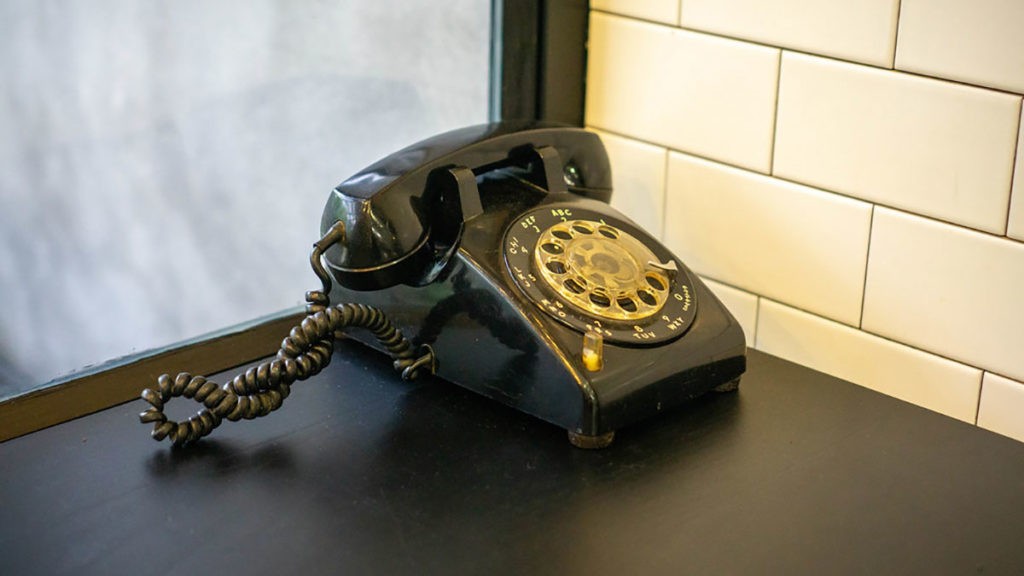
Corded telephones seems to be heading the way of the Dodo bird – extinct. That’s too bad when it comes to emergency preparedness. Here are some reasons why you need a landline for home safety and security.
It’s often noted how older technologies tend to work better during a disaster than newer ones. One example of such may be your landline telephone. Though very few Americans still have one (around 40%, actually), there still may be very good reasons for you to maintain access to your landline telephone. Let’s take a look at some of the reasons you may not want to turn to using your cell phone exclusively.
Now I wouldn’t be advocating for such measures if a corded phone cost hundreds of dollars – but they don’t! Amazon sells a basic AT&T corded phone for under $15 bucks!
#1 – Landlines Still Work in a Power Outage
Though, yes, technically your smart phone will still “work” in a power outage, that’s unlikely to be the case if the cell towers in your region lose power as well. And that’s not an unlikely scenario either. During Hurricane Sandy, about a fourth of all nearby cell towers went out of service. Many cell towers do have battery backups available, but these typically have no more than 4-6 hours’ worth of power before you’re once more without any means of phone communication. Landlines, however, will often have backup power for a week or more.
You might be thinking, Well if the power is out, it usually means a pole is down, there goes the phone lines, too. Maybe, but not necessarily. When a pole goes down the electric wires are grounded out, but telephone wires (sheathed in plastic) are not, so service remains (so long as the wires was not split in half). Switchboards may lose power, but they’re cranked up with all kinds of backup generator action. In a long-term SHTF situation a corded phone won’t help much, but it could provide critical communication in the early stages of TEOTWAWKI.
#2 – Landlines Give Better 911 GPS Coordinates
Let’s say that you live in a high-rise apartment, and your mom comes to visit. You go to do a grocery run as she stays at your place. Perchance she ends up falling and breaking her hip, and somehow manages to call 911, the emergency dispatcher won’t know what address to send help to if she can’t remember your address. Cell phones give locations, but not necessarily addresses.
A landline, however, is tied directly to your address. This means that as soon as you call 911 from a landline, the emergency dispatcher knows exactly where you’re calling from. It may be something to think of if you have older parents who spend a good deal of time at your house.
#3 – Landlines Are More Secure than Cellphones
While any form of communication can be hacked given the means, time, and know-how, landlines are far more secure than cellphones. There seems to be less of a risk of having your landline tapped than there is of having your smartphone hacked. As such, it’s typically more secure to give your banking information out over a landline (e.g., placing an order with a seed catalog) than it is to make the same transaction over your smart phone. Landlines are, for the average household, the most secure form of communication you can get.
A corded phone also better protects your privacy when providing credit card information or other information over the telephone (like rendezvous points and food storage locations). Conversations over a cordless phone can be intercepted by using anything from an eaves-dropping device to a basic baby monitor. A corded phone will help reduce the risk of identity fraud.
#4 – Landlines Don’t Run Out of Batteries
Yet another potential survival benefit of having a landline is that it doesn’t run out of batteries. Personally, my phone is lucky to last a day off of a single charge. Given that a disaster is likely to last much longer than 24 hours, if you don’t have some way of continually recharging your smart phone, you’re going to be screwed. There are no worries of such with a landline though.
Solid reasons so far? We’re only halfway through our list of why you need a landline.
#5 – Landlines Don’t Have Planned Obsolescence
One of the unfortunate things about most modern cell phones is that they are built to eventually fail. Apple admitted to doing such. I’ve had one of my smart phones completely go haywire immediately after I downloaded the most recent update. The second the update was finished, my older phone no longer worked, and I had to buy a new one. You don’t have to worry about such with a landline, however. There are no updates, so you can buy a phone once and just forget about it. No need to spend another $700+ every 3-5 years that way.
#6 – Landlines Make for More Reliable Calls
Yet another benefit of keeping a landline around is that there is an exponentially smaller chance that your call will be dropped. For instances where you may only get one shot to make a particular call, this could be something that you want to consider. In addition to greater call reliability, your audio is going to be much crisper than it would be if you called via a cell phone as well.
#7 – A Landline Can Potentially Be Used for Retreat Security
This one would take a bit of extra work, but it’s still a possibility. Rawles actually details this method in his book Patriots. What you need are two military field telephones and plenty of cable to connect the two together. Let’s say that you have a barn/stable/rally point away from your house. With a field telephone in each location, you can still communicate to each other even if your cell phones are dead, your radios are being jammed, or the like. It’s a pricier option, but it works, and it’s technically still considered a landline. You can regularly find these on eBay.
That would be more advanced landlines, however. Buying a simple corded telephone is a much easier step. Every prepper’s house should have at least one corded phone, preferably in the master bedroom or the basement. Planning to build a fallout shelter? Put one there, too.
#8 – Landlines Have “Secret Codes” You Can Use
Really, you can do all of these from your cell phone as well, but a landline is still capable of many of them as well. The very first hackers were known as “phone phreakers”, and some of these tips were common knowledge to them. None of these are illegal, they’re just under-utilized features that your phone company offers you aren’t likely to know about.
For more information on phone codes, check out the following links for your particular provider:
Sprint
- https://community.sprint.com/t5/Devices-Board/Here-is-a-list-of-Codes-for-Sprint-customers/td-p/490381
- https://bestcellular.com/dial-codes/
AT&T
Verizon
Why You Need a Landline Summary
Post-disaster communications are an area of prepping that I am growing more and more aware of the importance of, and I believe that it’s often one of the more overlooked aspects of prepping. Information saves lives, however. It enables you to make the wisest decision that you can. A lack of it inherently creates risky choices. As such, the prepper should do everything in his power to improve his disaster resiliency through proper communications planning. One of the ways that they can do such is through the retention of a landline phone in the home.
Of course, rotary phones have other uses that touch tone phones don’t. You can use them for modern art (as seen in the Museum of Communications).

Are there other reasons why you need a landline that we didn’t cover above? Do you have personal experience with the benefits of having a landline? Let us know in the comments below!
9 comments
I had a land line up until a couple of years ago. At $40 a month or however much it cost I just couldn’t justify it, anymore. I always had a corded phone in the house for the reasons that you mention (still have it actually) but it got too expensive for something that we literally never ever used. Can’t you still call 911 even if you don’t have phone service?
One small problem with your plan. For years the phone company used banks of batteries located at the switchers to keep the phone line on when the power goes out. The phone company has been slowly getting rid of these battery banks due to cost. So what you will need to do is ask someone at the local level of the phone company if they still have a battery backup system, backup gen, or grid only. If there is not backup battery banks or gen then it is pointless on the land line in the beginning. Now with that said a land line phone would be good after the fact if the local community gets back on it feet and places a gen or some other power supply at the switcher site so they will at least have local phone service.
We keep a couple corded phones stored in a shielded container in the closet, they come in handy during ice storms.
I like to store the ones that have the buttons on the handset, you can make a nice lineman’s handset out of them if needed.
I totally agree with you, Ranger Man. Cell phones, IMO, are sketchy at best. My husband has to have one on at all times for his work. I can’t count the number of times the office had to call our home number to get ahold of him because his cell didn’t work. I have had to use my corded phone numerous times due to power outages after severe and winter storms.
I still wonder why I must press 1 for English, thought this was America…
I have several corded phones in our home, along with the cells. One thing I’ve done is to place a small LED flashlight with every corded phone. Why? Because phones don’t move, and if you have a flashlight by the phone, you know where to find one in the dark! Beats stumbling down the stairs and looking through a junk drawer during an emergency for a working flashlight.
A lot of the phone companies are going digital and the home land line is not actually a land line, but a digital cable with a cable box that operates the phone and internet. If the electricity goes out, the cable box goes out too and so does the phone and internet, though some have a battery backup. Turn off your power at the fuse box (and disconnect the battery if there is one) and see if your phone still works, then you’ll know for sure.
Everything’s going digital these days. Within a few years (how few? Who knows.) there won’t be anything such as analog in this country. Then when the balloon goes up, we’ll really be in a comm. mess. but at least we’ll still have our preps. Two ways to help get around all of this are:
-get a hold of all of the analog electronics manuals you can (used book stores and yard sales are a good starting point), not to mention any paper based manuals for anything: cars, woodworking, first-aid, you name it.
-don’t set up a SHTF stronghold for just you and yours, but consider going in with a group of VERY TRUSTED people. half a dozen families each with a broad range of knowledge, as well as some specializations such as “x”-smithing (gun, black, tin), gardening, agriculture (plant an animal), food preservation, cooking, first aid (first responder or EMT training would be better), carpentry, masonry, etc. You all get the point.
Granted this all sounds a bit like a hippy commune, but it works much better than that (this would be filled with people who would actually do work).
Waking up an old thread, as we probably has observed the telco is not what it has been. We are not sure that it will work for hours and days in an power out anymore. Cellphones may work for a short time until battery backups are empty.